
October 2025 Contest — Grade 8
The October 2025 North Star contest paper for Grade 8 has 12 questions and a 60-minute limit. Two sample questions with worked solutions are below, and you can take the whole paper online for free — no account, no sign-up.
- Grade
- Grade 8
- Questions
- 12
- Time limit
- 60 minutes
- Contest
- October 2025
- Subject
- Mathematics
- School year
- 2025-26
Before you start
- The timer starts when you press Start and runs for 60 minutes.
- Answer the 12 questions in any order; each is multiple choice.
- Your answers are marked as you go. Nothing is saved to an account, so finish in one sitting.
Sample questions
The first and last questions from this paper, with their worked solutions.
Question 1 — Geometry & Measurement
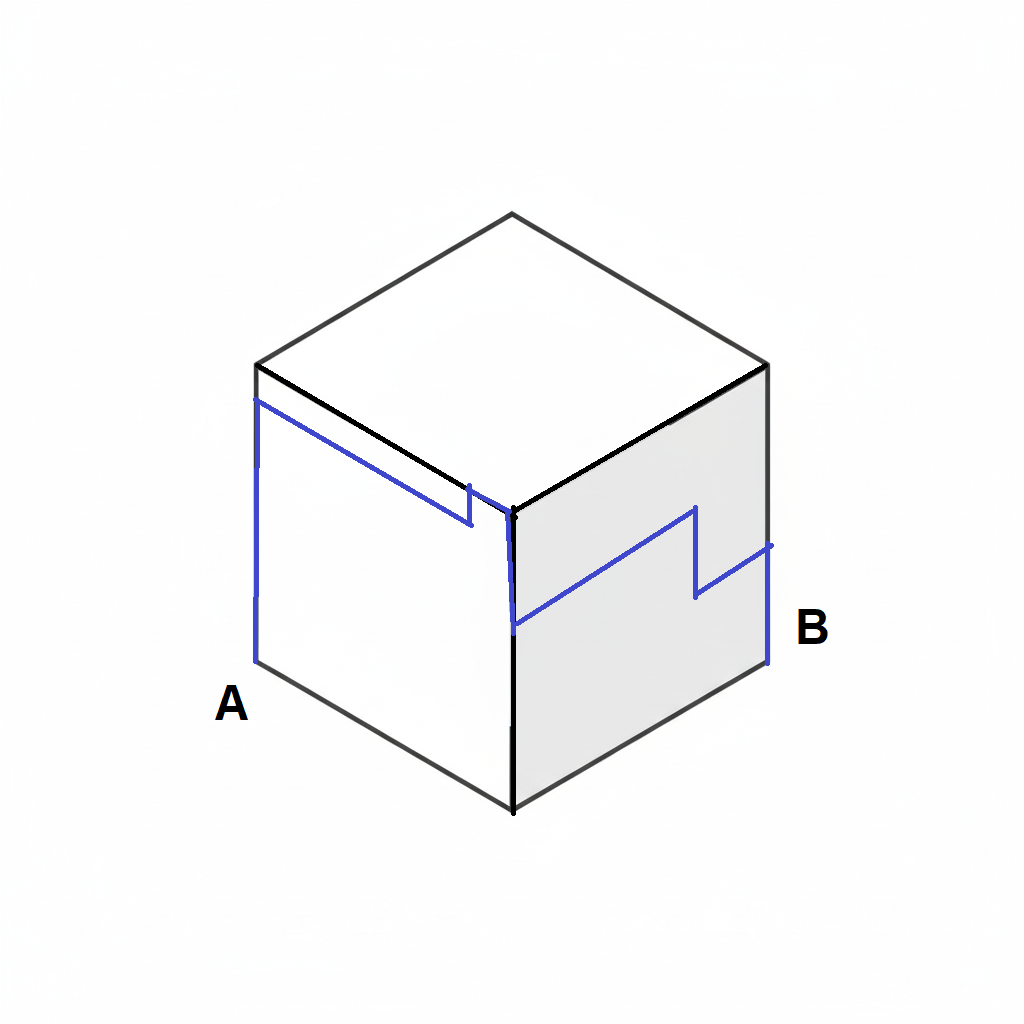
The diagram shows a cube with sides of length 14 cm. An insect is walking across the surface of the cube along the path shown in the image. If the insect always walks parallel to the edges, how far will it have to walk to reach point B from A.
- A.28
- B.56
- C.42
- D.70
- E.14
Show the worked solution
To find the total distance the insect walks from point A to point B, we can break the path down into horizontal segments (parallel to the bottom edges of the cube) and vertical segments (parallel to the vertical edges of the cube).
Step 1 — Read the image:
The cube has a side length of 14 cm.
The insect starts at point A, which is at the bottom-left corner of the front-left face (height 0).
The insect ends at point B, which is at the bottom-right corner of the front-right face (height 0).
The path consists of horizontal segments and vertical segments.
Step 2 — Solve:
1. Horizontal Distance:
On the front-left face, the insect walks horizontally in two segments. Together, these two segments span the entire width of the front-left face, which is equal to the side length of the cube: 14 cm.
On the front-right face, the insect also walks horizontally in two segments. Together, these two segments span the entire width of the front-right face, which is also 14 cm.
Therefore, the total horizontal distance is:
Horizontal Distance = 14 cm + 14 cm = 28 cm
2. Vertical Distance:
Let's trace the vertical movements of the insect by looking at the heights of each horizontal segment:
The insect starts at the bottom (height 0) and goes up to a height of h\_1.
It then steps down to a height of h\_2.
It steps down further along the middle vertical edge to a height of h\_3.
It steps up to a height of h\_4.
Finally, it steps down to the bottom (height 0) at point B.
Summing the lengths of these vertical segments:
First vertical segment (up): h\_1
Second vertical segment (down): h\_1 - h\_2
Third vertical segment (down): h\_2 - h\_3
Fourth vertical segment (up): h\_4 - h\_3
Fifth vertical segment (down): h\_4
Adding these together:
Vertical Distance = h\_1 + (h\_1 - h\_2) + (h\_2 - h\_3) + (h\_4 - h\_3) + h\_4
Vertical Distance = 2h\_1 + 2h\_4 - 2h\_3 = 2(h\_1 + h\_4 - h\_3)
From the geometry of the path, the height of the first horizontal segment (h\_1) plus the height of the step on the right face (h\_4 - h\_3) is equal to the total height of the cube, which is 14 cm:
h\_1 + (h\_4 - h\_3) = 14 cm
Substituting this back into our vertical distance equation:
Vertical Distance = 2 x 14 cm = 28 cm
3. Total Distance:
Total Distance = Horizontal Distance + Vertical Distance = 28 cm + 28 cm = 56 cm
Step 3 — Select:
Therefore, the insect has to walk 56 cm to reach point B from A.
The answer is B
Question 12 — Number Sense & Operations
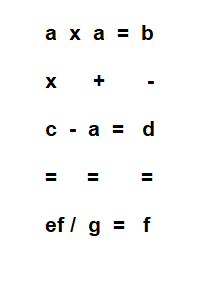
Identical letters stand for identical digits and different letters for different digits (for example, ab will be a 2-digit number with different digits). Determine the value of the letters such that all X horizontal computations and Y vertical computations are correct. Which of the following statements is correct?
- A.e=2
- B.f=6
- C.g=4
- D.a=2
- E.c=9
Show the worked solution
To solve this puzzle, we first identify the mathematical relationships from the grid. Let the letters a, b, c, d, e, f, g represent distinct single-digit numbers from 0 to 9.
Step 1: Identify the equations
From the horizontal rows:
1. a x a = b
2. c - a = d
3. ef / g = f (where ef is a two-digit number, i.e., 10e + f)
From the vertical columns:
4. a x c = ef
5. a + a = g
6. b - d = f
Step 2: Determine the values of the letters
From equation (5), we have:
g = 2a
Since g is a single digit, a must be less than 5. Also, a cannot be 0 because then g = 0, which violates the rule that different letters represent different digits.
From equation (1), we have:
b = a^2
Since b is a single digit, a can only be 1, 2, or 3.
If a = 1, then b = 1^2 = 1, which is a contradiction since a and b must be different.
If a = 2, then b = 2^2 = 4 and g = 2(2) = 4. This is a contradiction since b and g must be different.
If a = 3, then b = 3^2 = 9 and g = 2(3) = 6. This is a valid set of values.
Using a = 3, b = 9, and g = 6:
From equation (2):
c - 3 = d implies c = d + 3
From equation (6):
9 - d = f implies d + f = 9
From equation (4):
3 x c = ef
Since c = d + 3, let's test possible values for d (where d is a digit and c le 9):
If d = 5, then c = 8.
This gives 3 x c = 3 x 8 = 24, which means ef = 24, so e = 2 and f = 4.
Let's check if d + f = 9: 5 + 4 = 9, which is correct.
Let's check if all digits are distinct: a=3, b=9, c=8, d=5, e=2, f=4, g=6. All digits are indeed distinct.
Let's verify equation (3): ef / g = 24 / 6 = 4 = f, which is correct.
Thus, the unique solution is:
a = 3
b = 9
c = 8
d = 5
e = 2
f = 4
g = 6
Comparing this with the options:
A) e=2 (Correct)
B) f=6 (Incorrect, f=4)
C) g=4 (Incorrect, g=6)
D) a=2 (Incorrect, a=3)
E) c=9 (Incorrect, c=8)
The answer is A
Take the whole paper
All 12 questions, 60 minutes, marked as you go. No account needed.