
January 2026 Contest — Grade 8
The January 2026 North Star contest paper for Grade 8 has 12 questions and a 60-minute limit. Two sample questions with worked solutions are below, and you can take the whole paper online for free — no account, no sign-up.
- Grade
- Grade 8
- Questions
- 12
- Time limit
- 60 minutes
- Contest
- January 2026
- Subject
- Mathematics
- School year
- 2025-26
Before you start
- The timer starts when you press Start and runs for 60 minutes.
- Answer the 12 questions in any order; each is multiple choice.
- Your answers are marked as you go. Nothing is saved to an account, so finish in one sitting.
Sample questions
The first and last questions from this paper, with their worked solutions.
Question 1 — Geometry & Measurement
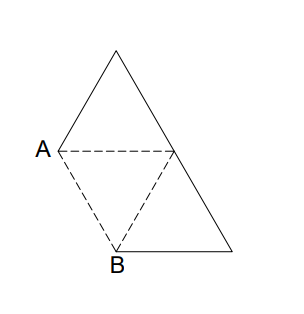
Roy runs on a jogging track from A to B which is shown with solid lines. When we draw the dotted lines, we can see three equilateral triangles. If the dotted line from A to B is 100 meters, what is the length of the jogging track in meters?
- A.100
- B.200
- C.300
- D.400
- E.500
Show the worked solution
Step 1 — Read the image
By observing the image, we can identify the following visual elements:
A geometric figure with vertices labeled A (on the left) and B (at the bottom-left).
Solid lines forming the outer boundary on the top-left, right, and bottom sides.
Dotted (dashed) lines forming an inner triangle with vertices A, B, and a middle-right vertex (let's call it C).
The dotted line from A to B is a single segment of length 100 meters.
The solid lines form a continuous path (the jogging track) starting at A, going up to the top vertex, down the right side, and ending at B.
Step 2 — Solve
The problem states that drawing the dotted lines reveals three equilateral triangles:
1. The top triangle (with vertices A, the top vertex, and C)
2. The middle triangle (with vertices A, B, and C)
3. The bottom-right triangle (with vertices B, the bottom-right vertex, and C)
Since these three triangles share sides, they are all congruent and have the same side length.
The dotted line from A to B is a side of the middle equilateral triangle, so the side length of each of the three triangles is 100 meters.
The jogging track along the solid lines consists of four sides of these equilateral triangles:
From A to the top vertex: 100 meters
From the top vertex to the middle-right vertex C: 100 meters
From C to the bottom-right vertex: 100 meters
From the bottom-right vertex to B: 100 meters
Adding these four segments together, we get:
Total length = 100 + 100 + 100 + 100 = 400 meters
Step 3 — Select
The correct option is D.
The answer is D
Question 12 — Logical Reasoning & Problem Solving
A train consists of 18 carriages carrying a total of 700 passengers. The passengers are distributed such that any block of 5 adjacent carriages contains exactly 199 passengers. What is the total number of passengers in the two middle carriages of the train?
- A.99
- B.97
- C.96
- D.95
- E.94
Show the worked solution
To find the total number of passengers in the two middle carriages of the train, let us represent the number of passengers in each of the 18 carriages as x\_1, x\_2, dots, x\_18.
We are given that any block of 5 adjacent carriages contains exactly 199 passengers. This means:
x\_i + x\_i+1 + x\_i+2 + x\_i+3 + x\_i+4 = 199
x\_i+1 + x\_i+2 + x\_i+3 + x\_i+4 + x\_i+5 = 199
Subtracting the first equation from the second gives:
x\_i+5 - x\_i = 0 implies x\_i+5 = x\_i
This shows that the number of passengers in the carriages repeats in a periodic pattern of 5. Let the number of passengers in the first 5 carriages be a, b, c, d, e. Thus, the sum of any 5 adjacent carriages is:
a + b + c + d + e = 199
The sequence of passengers in the 18 carriages of the train is:
a, b, c, d, e, a, b, c, d, e, a, b, c, d, e, a, b, c
The total number of passengers in all 18 carriages is 700. We can write this total sum as:
(a + b + c + d + e) + (a + b + c + d + e) + (a + b + c + d + e) + (a + b + c) = 700
3(a + b + c + d + e) + (a + b + c) = 700
Substituting a + b + c + d + e = 199 into the equation:
3(199) + (a + b + c) = 700
597 + (a + b + c) = 700
a + b + c = 700 - 597 = 103
Now, we can find the value of d + e:
d + e = (a + b + c + d + e) - (a + b + c)
d + e = 199 - 103 = 96
The train has 18 carriages, so the two middle carriages are the 9th and 10th carriages. According to our periodic sequence, the 9th carriage has d passengers and the 10th carriage has e passengers.
Therefore, the total number of passengers in the two middle carriages is:
x\_9 + x\_10 = d + e = 96
The answer is C.
Take the whole paper
All 12 questions, 60 minutes, marked as you go. No account needed.