
June 2026 Contest — Grade 6
The June 2026 North Star contest paper for Grade 6 has 12 questions and a 60-minute limit. Two sample questions with worked solutions are below, and you can take the whole paper online for free — no account, no sign-up.
- Grade
- Grade 6
- Questions
- 12
- Time limit
- 60 minutes
- Contest
- June 2026
- Subject
- Mathematics
- School year
- 2025-26
Before you start
- The timer starts when you press Start and runs for 60 minutes.
- Answer the 12 questions in any order; each is multiple choice.
- Your answers are marked as you go. Nothing is saved to an account, so finish in one sitting.
Sample questions
The first and last questions from this paper, with their worked solutions.
Question 1 — Logical Reasoning & Problem Solving
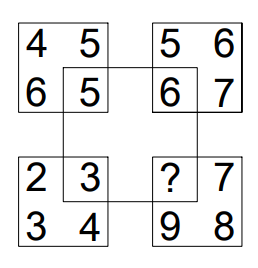
If the numbers in the boxes follow a pattern, what is the missing number?
- A.5
- B.6
- C.7
- D.8
- E.None of these
Show the worked solution
To find the missing number, let's first analyze the layout and the numbers in the image.
Step 1 — Read the image:
We have four outer squares at the corners and one central square that overlaps with the inner corner of each outer square:
1. Top-Left (TL) Square contains the numbers:
Outer: 4, 5, 6
Inner (overlapping): 5
2. Top-Right (TR) Square contains the numbers:
Outer: 5, 6, 7
Inner (overlapping): 6
3. Bottom-Left (BL) Square contains the numbers:
Outer: 2, 3, 4
Inner (overlapping): 3
4. Bottom-Right (BR) Square contains the numbers:
Outer: 7, 8, 9
Inner (overlapping): ?
---
Step 2 — Solve:
We can find the missing number using multiple consistent patterns:
Method 1: Row Sum of the Central Overlapping Square
Let's look at the four numbers inside the central overlapping square:
Top row: 5 and 6
Bottom row: 3 and ?
If we sum the numbers in the top row of this central square:
5 + 6 = 11
For the bottom row to have the same sum:
3 + ? = 11 implies ? = 8
Method 2: Top and Bottom Total Sums
Let's calculate the sum of all numbers in the top two squares and compare it to the sum of all numbers in the bottom two squares:
Sum of Top Squares (TL + TR):
(4 + 5 + 6 + 5) + (5 + 6 + 6 + 7) = 20 + 24 = 44
Sum of Bottom Squares (BL + BR):
(2 + 3 + 3 + 4) + (? + 7 + 9 + 8) = 12 + (24 + ?) = 36 + ?
Setting the top sum equal to the bottom sum:
36 + ? = 44 implies ? = 8
Method 3: Left-Right Symmetry of Differences
Left Side (TL and BL):
Difference between the outer sums: (4 + 5 + 6) - (2 + 3 + 4) = 15 - 9 = 6
Difference between the inner numbers: 5 - 3 = 2
Right Side (BR and TR):
Difference between the outer sums: (7 + 8 + 9) - (5 + 6 + 7) = 24 - 18 = 6
Difference between the inner numbers must also be 2:
? - 6 = 2 implies ? = 8
All three methods consistently show that the missing number is 8.
---
Step 3 — Select:
The correct option is D.
The answer is D
Question 12 — Logical Reasoning & Problem Solving
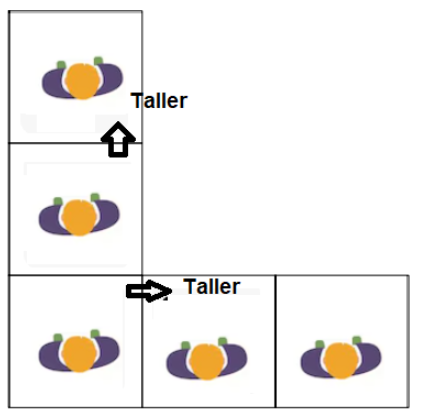
Five students of different heights (ranked 1 to 5) are arranged in an L-shaped formation. They must stand in such a way that the student in front is always taller and the student on the right is always taller. In how many ways can the students stand so that they satisfy the rule?
- A.2
- B.6
- C.8
- D.10
- E.None of these
Show the worked solution
Step 1 — Read the image:
We have 5 squares arranged in an L-shape.
Let's label the positions of the squares:
A: the bottom-left corner square.
B: the middle square in the vertical column (directly above A).
C: the top square in the vertical column (directly above B).
D: the middle square in the horizontal row (directly to the right of A).
E: the rightmost square in the horizontal row (directly to the right of D).
There are 5 students of different heights, which we can rank from 1 (shortest) to 5 (tallest).
The rules are:
"The student in front is always taller."
"The student on the right is always taller."
Step 2 — Solve:
Let's analyze the possible arrangements based on the directional rules:
1. First Configuration:
If the vertical column height increases going upwards (C > B > A) and the horizontal row height decreases going to the right (A > D > E), we get a single continuous chain of inequalities:
C > B > A > D > E
Since there are 5 distinct heights (1 to 5), there is exactly 1 way to arrange the students in this chain:
C = 5, quad B = 4, quad A = 3, quad D = 2, quad E = 1
2. Second Configuration:
If the vertical column height decreases going downwards (A > B > C) and the horizontal row height increases going to the right (E > D > A), we get another single continuous chain of inequalities:
E > D > A > B > C
There is exactly 1 way to arrange the students in this chain:
E = 5, quad D = 4, quad A = 3, quad B = 2, quad C = 1
Combining these configurations, we find there are exactly 1 + 1 = 2 ways for the students to stand and satisfy the rules.
Step 3 — Select:
The correct option is A.
The answer is A
Take the whole paper
All 12 questions, 60 minutes, marked as you go. No account needed.