
January 2026 Contest — Grade 6
The January 2026 North Star contest paper for Grade 6 has 12 questions and a 60-minute limit. Two sample questions with worked solutions are below, and you can take the whole paper online for free — no account, no sign-up.
- Grade
- Grade 6
- Questions
- 12
- Time limit
- 60 minutes
- Contest
- January 2026
- Subject
- Mathematics
- School year
- 2025-26
Before you start
- The timer starts when you press Start and runs for 60 minutes.
- Answer the 12 questions in any order; each is multiple choice.
- Your answers are marked as you go. Nothing is saved to an account, so finish in one sitting.
Sample questions
The first and last questions from this paper, with their worked solutions.
Question 1 — Geometry & Measurement
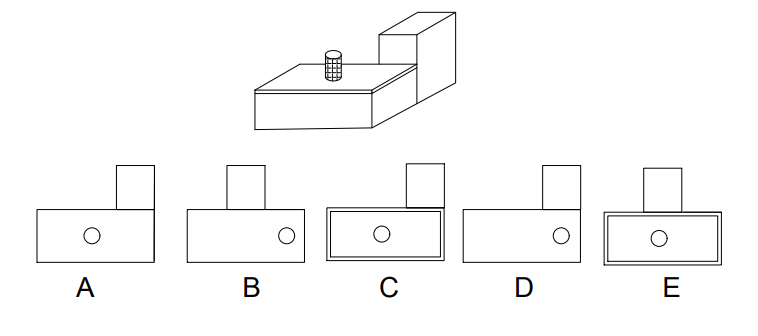
A modern art sculpture consists of a cylinder, and two cuboids. If a drone takes a photo from directly overhead, which set of 2D shapes will appear in the photo?
- A.A
- B.B
- C.C
- D.D
- E.E
Show the worked solution
To find the correct 2D overhead view (top-down view) of the sculpture, we can analyze each component and its position:
1. The large horizontal cuboid: From directly overhead, this will appear as a large rectangle. Looking closely at the 3D drawing, there is a distinct border or rim around the top surface of this cuboid. This means the top-down view of this cuboid must show a double border (an inner rectangle inside the outer rectangle).
2. The cylinder: The cylinder is standing vertically in the center of the top face of the horizontal cuboid. From directly overhead, a cylinder appears as a circle. Since it is in the center, the circle must be located in the middle of the large rectangle.
3. The tall vertical cuboid: This cuboid is located at the back-right of the horizontal cuboid. From directly overhead, it will appear as a smaller rectangle attached to the top-right edge of the large rectangle.
Comparing these features with the given options:
Option A has the smaller rectangle on the right and the circle in the center, but lacks the double border.
Option B has the smaller rectangle in the center and the circle on the right.
Option C has the smaller rectangle on the right, the circle in the center, and the double border on the large rectangle.
Option D has the circle on the right.
Option E has the smaller rectangle in the center.
Therefore, the correct overhead view is represented by C.
The answer is C
Question 12 — Advanced Mathematics
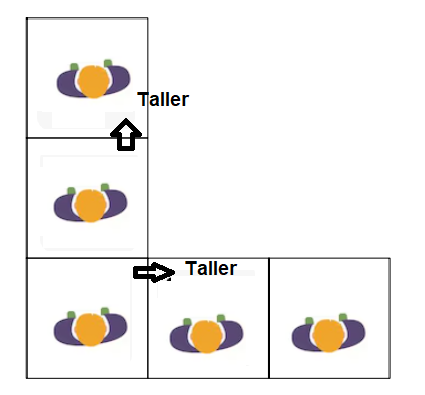
Five students of different heights (ranked 1 to 5) are arranged in an L-shaped formation. They must stand in such a way that the student in front is always taller and the student on the right is always taller. In how many ways can the students stand so that they satisfy the rule?
- A.5
- B.6
- C.8
- D.10
- E.12
Show the worked solution
Step 1 — Read the image
The image shows 5 squares arranged in an L-shape: a vertical column of 3 squares on the left and a horizontal row of 3 squares at the bottom, sharing the bottom-left square.
Each square contains a student icon.
There is an arrow pointing UP from the middle-left square to the top-left square, labeled "Taller".
There is an arrow pointing RIGHT from the bottom-left square to the bottom-middle square, labeled "Taller".
The question states: "the student in front is always taller and the student on the right is always taller."
Step 2 — Solve
Let us label the 5 positions in the L-shape as follows:
A: bottom-left square
B: middle-left square
C: top-left square
D: bottom-middle square
E: bottom-right square
Based on the rules:
1. In front is always taller (vertical column):
C > B > A
2. On the right is always taller (horizontal row):
E > D > A
Since A is smaller than both B and D, and we know B < C and D < E, A must be the smallest height among all 5 students. Thus, the student of height 1 must stand at position A:
A = 1
The remaining heights to be distributed among the other four positions (\{B, C, D, E\}) are \{2, 3, 4, 5\}.
To satisfy the conditions C > B and E > D:
We need to choose 2 heights from \{2, 3, 4, 5\} for the vertical branch \{B, C\}. Once chosen, they can only be placed in one unique order (the smaller one at B and the larger one at C).
The remaining 2 heights will automatically go to the horizontal branch \{D, E\}, also in a unique order (the smaller one at D and the larger one at E).
The number of ways to choose 2 heights out of 4 is:
binom{4}{2} = 4 x 3/2 x 1 = 6
Let's list the 6 valid arrangements of (A, B, C, D, E):
1. (1, 2, 3, 4, 5)
2. (1, 2, 4, 3, 5)
3. (1, 2, 5, 3, 4)
4. (1, 3, 4, 2, 5)
5. (1, 3, 5, 2, 4)
6. (1, 4, 5, 2, 3)
Thus, there are exactly 6 ways for the students to stand.
Step 3 — Select
The correct option is B.
The answer is B
Take the whole paper
All 12 questions, 60 minutes, marked as you go. No account needed.