
November 2025 Contest — Grade 5
The November 2025 North Star contest paper for Grade 5 has 12 questions and a 60-minute limit. Two sample questions with worked solutions are below, and you can take the whole paper online for free — no account, no sign-up.
- Grade
- Grade 5
- Questions
- 12
- Time limit
- 60 minutes
- Contest
- November 2025
- Subject
- Mathematics
- School year
- 2025-26
Before you start
- The timer starts when you press Start and runs for 60 minutes.
- Answer the 12 questions in any order; each is multiple choice.
- Your answers are marked as you go. Nothing is saved to an account, so finish in one sitting.
Sample questions
The first and last questions from this paper, with their worked solutions.
Question 1 — Number Sense & Operations
Sam, who is older than Jackie by one year plus one day, was born on December 31, 2005. What is the date Jackie was born?
- A.December 31, 2006
- B.December 31, 2007
- C.January 31, 2007
- D.January 1, 2007
- E.January 1, 2006
Show the worked solution
To find Jackie's birth date, we can use the information given about their ages:
1. Sam is older than Jackie, which means Jackie is younger and was born after Sam.
2. The difference in their ages is exactly 1 year and 1 day.
3. Sam was born on December 31, 2005.
Now, let's add 1 year and 1 day to Sam's birth date to find when Jackie was born:
Adding exactly 1 year to December 31, 2005 brings us to December 31, 2006.
Adding 1 more day to December 31, 2006 brings us to the next day, which is January 1, 2007.
Therefore, Jackie was born on January 1, 2007.
The answer is D
Question 12 — Logical Reasoning & Problem Solving
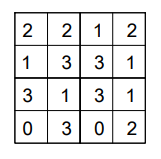
Sam is playing a game where each square may or may not contain gold. Each square has a number that shows how many neighbouring squares have gold in them. For two squares to be neighbouring squares they must share one side. Based on the below image, how many squares have gold in them?
- A.7
- B.8
- C.9
- D.10
- E.11
Show the worked solution
To solve this puzzle, let's represent the grid as a 4-by-4 table where each square is identified by its row (from top to bottom, 1 to 4) and column (from left to right, 1 to 4).
Step 1 — Read the image
The numbers in each square of the grid are:
Row 1: 2, 2, 1, 2
Row 2: 1, 3, 3, 1
Row 3: 3, 1, 3, 1
Row 4: 0, 3, 0, 2
Each number shows how many of its neighbouring squares (sharing a side) contain gold.
Step 2 — Solve
Let's find which squares contain gold step-by-step:
1. Look at the 0s in Row 4:
The square at Row 4, Column 1 has a `0`. Its neighbours are Row 3, Column 1 and Row 4, Column 2. Neither of these can have gold.
The square at Row 4, Column 3 has a `0`. Its neighbours are Row 3, Column 3, Row 4, Column 2, and Row 4, Column 4. None of these can have gold.
Therefore, the following squares do not have gold:
- Row 3, Column 1
- Row 3, Column 3
- Row 4, Column 2
- Row 4, Column 4
2. Look at the other squares in Row 4:
The square at Row 4, Column 2 has a `3`. Its only neighbours are Row 4, Column 1, Row 4, Column 3, and Row 3, Column 2. Since it has exactly 3 neighbours and the count is 3, all of them must have gold:
- Row 4, Column 1 (has gold)
- Row 4, Column 3 (has gold)
- Row 3, Column 2 (has gold)
The square at Row 4, Column 4 has a `2`. Its only neighbours are Row 4, Column 3 and Row 3, Column 4. Since it has exactly 2 neighbours and the count is 2, both must have gold:
- Row 4, Column 3 (already known to have gold)
- Row 3, Column 4 (has gold)
3. Look at the squares in Row 3:
The square at Row 3, Column 1 has a `3`. Its neighbours are Row 2, Column 1, Row 4, Column 1, and Row 3, Column 2. We know Row 4, Column 1 and Row 3, Column 2 have gold. To reach a total of 3, the remaining neighbour must have gold:
- Row 2, Column 1 (has gold)
The square at Row 3, Column 2 has a `1`. Its neighbours are Row 2, Column 2, Row 4, Column 2, Row 3, Column 1, and Row 3, Column 3. We know Row 4, Column 2, Row 3, Column 1, and Row 3, Column 3 do not have gold. To reach a total of 1, the remaining neighbour must have gold:
- Row 2, Column 2 (has gold)
The square at Row 3, Column 3 has a `3`. Its neighbours are Row 2, Column 3, Row 4, Column 3, Row 3, Column 2, and Row 3, Column 4. We know Row 4, Column 3, Row 3, Column 2, and Row 3, Column 4 all have gold. Since we already have 3 gold neighbours, the remaining neighbour must not have gold:
- Row 2, Column 3 (does not have gold)
The square at Row 3, Column 4 has a `1`. Its neighbours are Row 2, Column 4, Row 4, Column 4, and Row 3, Column 3. We know Row 4, Column 4 and Row 3, Column 3 do not have gold. To reach a total of 1, the remaining neighbour must have gold:
- Row 2, Column 4 (has gold)
4. Look at the squares in Row 2:
The square at Row 2, Column 1 has a `1`. Its neighbours are Row 1, Column 1, Row 3, Column 1, and Row 2, Column 2. We know Row 3, Column 1 does not have gold, and Row 2, Column 2 has gold. Since we already have 1 gold neighbour, the remaining neighbour must not have gold:
- Row 1, Column 1 (does not have gold)
The square at Row 2, Column 2 has a `3`. Its neighbours are Row 1, Column 2, Row 3, Column 2, Row 2, Column 1, and Row 2, Column 3. We know Row 3, Column 2 and Row 2, Column 1 have gold, and Row 2, Column 3 does not. To reach a total of 3, the remaining neighbour must have gold:
- Row 1, Column 2 (has gold)
The square at Row 2, Column 3 has a `3`. Its neighbours are Row 1, Column 3, Row 3, Column 3, Row 2, Column 2, and Row 2, Column 4. We know Row 3, Column 3 does not have gold, and Row 2, Column 2 and Row 2, Column 4 have gold. To reach a total of 3, the remaining neighbour must have gold:
- Row 1, Column 3 (has gold)
The square at Row 2, Column 4 has a `1`. Its neighbours are Row 1, Column 4, Row 3, Column 4, and Row 2, Column 3. We know Row 3, Column 4 has gold, and Row 2, Column 3 does not. Since we already have 1 gold neighbour, the remaining neighbour must not have gold:
- Row 1, Column 4 (does not have gold)
Step 3 — Select
Let's list all the squares that contain gold:
Row 1: Column 2, Column 3 (2 squares)
Row 2: Column 1, Column 2, Column 4 (3 squares)
Row 3: Column 2, Column 4 (2 squares)
Row 4: Column 1, Column 3 (2 squares)
Adding these up: 2 + 3 + 2 + 2 = 9 squares contain gold.
The answer is C.
Take the whole paper
All 12 questions, 60 minutes, marked as you go. No account needed.