
June 2026 Contest — Grade 5
The June 2026 North Star contest paper for Grade 5 has 12 questions and a 60-minute limit. Two sample questions with worked solutions are below, and you can take the whole paper online for free — no account, no sign-up.
- Grade
- Grade 5
- Questions
- 12
- Time limit
- 60 minutes
- Contest
- June 2026
- Subject
- Mathematics
- School year
- 2025-26
Before you start
- The timer starts when you press Start and runs for 60 minutes.
- Answer the 12 questions in any order; each is multiple choice.
- Your answers are marked as you go. Nothing is saved to an account, so finish in one sitting.
Sample questions
The first and last questions from this paper, with their worked solutions.
Question 1 — Logical Reasoning & Problem Solving
Sophie has 3 shapes with different weights. When she places shapes A and B on a weighing machine, the reading is 400 grams. If she replaces A with C, the reading goes up by 100 grams. If she replaces B with C, the reading goes down by 100 grams. What is the total weight of A, B and C in grams?
- A.100
- B.500
- C.600
- D.400
- E.None of these
Show the worked solution
Let's solve this step-by-step using the clues given in the problem:
1. First clue: The total weight of shapes A and B is 400 grams.
Weight of A + Weight of B = 400 grams
2. Second clue: Replacing A with C makes the reading go up by 100 grams.
This means shape C is 100 grams heavier than shape A.
Weight of C = Weight of A + 100 grams
3. Third clue: Replacing B with C makes the reading go down by 100 grams.
This means shape C is 100 grams lighter than shape B, which also means shape B is 100 grams heavier than shape C.
Weight of B = Weight of C + 100 grams
Now, let's compare the weights of A, B, and C:
Since C is 100 grams heavier than A, and B is 100 grams heavier than C, then B must be 200 grams heavier than A (100 grams + 100 grams).
We know that A and B together weigh 400 grams:
If we subtract the extra 200 grams that B has from the total of 400 grams, we get 200 grams.
Dividing this remaining amount equally between A and B gives 100 grams.
So, shape A weighs 100 grams.
Shape B weighs 100 grams + 200 grams = 300 grams.
Shape C is 100 grams heavier than A, so shape C weighs 100 grams + 100 grams = 200 grams.
Let's double-check our weights:
A + B = 100 + 300 = 400 grams (Correct)
C + B = 200 + 300 = 500 grams (100 grams more than 400, Correct)
A + C = 100 + 200 = 300 grams (100 grams less than 400, Correct)
Finally, we find the total weight of A, B, and C:
Total weight = 100 grams + 300 grams + 200 grams = 600 grams.
The answer is C
Question 12 — Geometry & Measurement
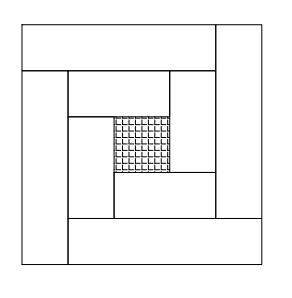
John fits 8 rectangular wooden tiles together to form a large square with an empty square hole in the middle. Every tile has the exact same width. The small square hole in the center has a side length of 6 cm, which is same as the width of each rectangle. What is the side length of the large outer square?
- A.12
- B.18
- C.24
- D.30
- E.None of these
Show the worked solution
To find the side length of the large outer square, we can break down the shape step-by-step from the inside out:
Step 1 — Read the image:
There is a central shaded square hole.
Surrounding this hole is an inner ring of 4 rectangular tiles.
Surrounding the inner ring is an outer ring of 4 rectangular tiles.
Every tile has the same width, which is 6 cm.
The central square hole has a side length of 6 cm.
Step 2 — Solve:
1. Find the side length of the inner square:
The inner square is made of the central square hole and the 4 inner rectangular tiles surrounding it. Looking at the horizontal span of this inner square, it consists of:
The width of the left inner tile (6 cm)
The side length of the central square hole (6 cm)
The width of the right inner tile (6 cm)
Adding these together:
Inner Square Side = 6 cm + 6 cm + 6 cm = 18 cm
2. Find the side length of the large outer square:
The outer square is made of the inner square and the 4 outer rectangular tiles surrounding it. Looking at the horizontal span of the large outer square, it consists of:
The width of the left outer tile (6 cm)
The side length of the inner square (18 cm)
The width of the right outer tile (6 cm)
Adding these together:
Outer Square Side = 6 cm + 18 cm + 6 cm = 30 cm
Step 3 — Select:
Therefore, the side length of the large outer square is 30 cm.
The answer is D
Take the whole paper
All 12 questions, 60 minutes, marked as you go. No account needed.