
March 2026 Contest — Grade 4
The March 2026 North Star contest paper for Grade 4 has 12 questions and a 45-minute limit. Two sample questions with worked solutions are below, and you can take the whole paper online for free — no account, no sign-up.
- Grade
- Grade 4
- Questions
- 12
- Time limit
- 45 minutes
- Contest
- March 2026
- Subject
- Mathematics
- School year
- 2025-26
Before you start
- The timer starts when you press Start and runs for 45 minutes.
- Answer the 12 questions in any order; each is multiple choice.
- Your answers are marked as you go. Nothing is saved to an account, so finish in one sitting.
Sample questions
The first and last questions from this paper, with their worked solutions.
Question 1 — Geometry & Measurement
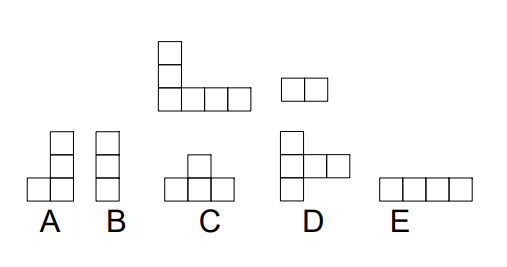
John has the two pieces shown at the top. He wants to combine them with one more piece to build a solid 3 X 4 rectangle. Which of the pieces (A, B, C, D, or E) is the missing piece he needs?
- A.A
- B.B
- C.C
- D.D
- E.E
Show the worked solution
To find the correct missing piece, let's follow these simple steps:
Step 1 — Read the image and count the squares:
A solid 3 x 4 rectangle has a total of 3 x 4 = 12 squares.
Let's count the squares in the two pieces shown at the top:
The large L-shaped piece has 6 squares (a vertical column of 3 squares and a horizontal row of 4 squares, sharing the corner square).
The smaller piece is a 1 x 2 rectangle, which has 2 squares.
Together, these two pieces have 6 + 2 = 8 squares.
Therefore, the missing piece must have exactly 12 - 8 = 4 squares.
Step 2 — Check the options:
A has 4 squares.
B has 3 squares.
C has 4 squares.
D has 5 squares.
E has 4 squares.
Since the missing piece must have 4 squares, we can eliminate B and D.
Step 3 — Fit the pieces together:
Imagine a 3 x 4 grid (3 rows and 4 columns).
Place the large L-shaped piece so that it covers the entire left column (3 squares) and the entire bottom row (4 squares).
This leaves an empty 2 x 3 rectangular space in the top-right area.
Place the 1 x 2 piece horizontally in the top-right corner of this empty space.
The remaining empty space consists of 4 squares: a horizontal row of 3 squares with 1 square on top of the left end.
If we take piece A and rotate it 90^circ clockwise, it fits this remaining space perfectly.
Thus, the missing piece John needs is A.
The answer is A
Question 12 — Algebra & Expressions
John has a cube where every side has a secret number hidden behind a colored patch. There are six colors in total, and they come in opposite pairs:
- Yellow is on the opposite side of Green.
- Red is on the opposite side of Orange.
- Blue is on the opposite side of Purple.
To find the hidden values, John was given three clues:
- The numbers on Yellow + Blue + Red add up to 18.
- The numbers on Green + Orange + Purple add up to 36.
- The numbers on Yellow + Blue + Orange add up to 23.
Can you help John figure out what the numbers on Red + Purple + Green add up to?
- A.46
- B.31
- C.41
- D.54
- E.27
Show the worked solution
To solve this problem, let's look at the information step-by-step:
Step 1 — Read the image:
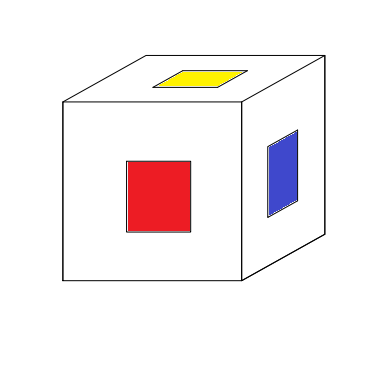
The image shows a cube with three visible faces containing colored patches:
The top face has a Yellow patch.
The front face has a Red patch.
The right face has a Blue patch.
Step 2 — Solve:
We are given the following clues about the numbers hidden behind the colored patches:
1. The sum of the numbers on Yellow + Blue + Red is 18.
2. The sum of the numbers on Green + Orange + Purple is 36.
3. The sum of the numbers on Yellow + Blue + Orange is 23.
First, let's find the total sum of all six numbers on the cube. Since the six colors are Yellow, Green, Red, Orange, Blue, and Purple, we can add the first two clues together:
Total Sum = (Yellow + Blue + Red) + (Green + Orange + Purple)
Total Sum = 18 + 36 = 54
Now, we want to find the sum of the numbers on Red + Purple + Green.
We know that the total sum of all six colors is 54. We can group these six colors into two sets of three:
One set is Yellow + Blue + Orange.
The other set is Red + Purple + Green.
So:
(Yellow + Blue + Orange) + (Red + Purple + Green) = 54
We are given that the sum of the first set (Yellow + Blue + Orange) is 23:
23 + (Red + Purple + Green) = 54
To find the sum of Red + Purple + Green, we subtract 23 from 54:
Red + Purple + Green = 54 - 23 = 31
Step 3 — Select:
The correct option is B.
The answer is B
Take the whole paper
All 12 questions, 45 minutes, marked as you go. No account needed.