
Grade 3 Math Problems: What a Good One Actually Looks Like (US & Canada)
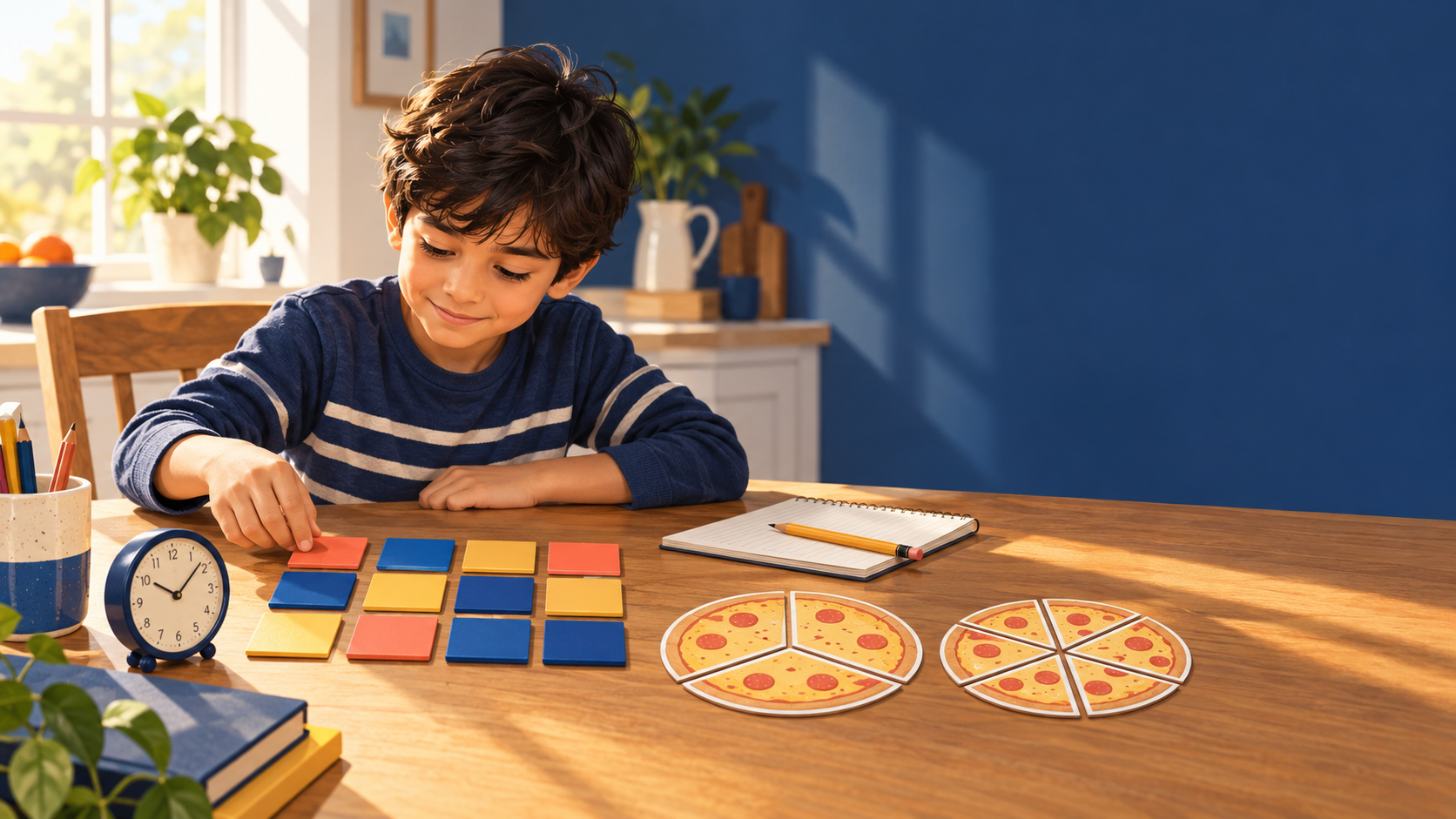
What does a good grade 3 math problem look like? 18 sample problems with answers, plus how US states and Canadian provinces differ.
In Miami, an 8-year-old is expected to multiply any two numbers up to 12 by the end of the year. In Vancouver, an 8-year-old of the same age isn't expected to memorize multiplication facts at all.
Same age. Same grade. Very different math.
That makes "grade 3 math problems" one of the most confusing searches a parent can type. Most results hand you a worksheet of 40 near-identical questions. They don't say whether those questions fit your child's curriculum. They also don't say whether the questions are any good.
This guide covers both. First, what makes a grade 3 math problem good. Then, what each province and state expects. At the end you'll find 18 sample problems with answers and a long FAQ.
The short answer: 5 signs of a good grade 3 math problem
Grade 3 is the year math changes from counting to structure. Children stop asking "how many?" and start asking "how many groups of how many?" A good problem makes the most of that change.
A good grade 3 math problem:
- Makes the child choose the operation. "7 × 8 = ?" practises a fact. "Seven teams each need 8 pinnies. How many pinnies?" is a problem. Deciding to multiply is the skill being tested.
- Uses numbers the child can hold in their head. The difficulty should come from the thinking. Grade 3 numbers mostly stay within 1,000 for adding and within 100 for multiplying.
- Has more than one way in. A child might skip-count, draw an array, or use a known fact. All three are valid, and good problems allow all three.
- Asks for a sensible answer, not just a number. If 50 cupcakes go into boxes of 6, the answer is 9 boxes, not "8 remainder 2."
- Is short to read and slow to solve. A problem that takes more time to read than to think about is testing reading, not math.
A worksheet tells you whether a child can compute. A good problem tells you whether they understand what they're computing.
What grade 3 math covers almost everywhere
Standards differ in the details, but the main topics of grade 3 are similar across North America:
- Place value to the thousands (and in some places, ten thousands)
- Adding and subtracting multi-digit numbers, with regrouping
- Multiplication and division as ideas: equal groups, arrays, sharing
- Fractions as numbers, not just "pieces of pizza"
- Measurement: length, mass, capacity, time, perimeter (and area in many places)
- Geometry: sorting 2D shapes and 3D objects by their properties
- Data: bar graphs and pictographs
- Patterns and early algebra: missing numbers, simple equations
Texas is a typical example. Its state test expects third graders to add and subtract within 1,000, multiply and divide within 100, place fractions on a number line, solve elapsed-time problems, find the area and perimeter of rectangles, classify 2D shapes, and read pictographs and bar graphs. Change the unit names and that list would fit most of the continent.
The differences show up in three places: how far multiplication goes, which fractions are included, and what extra topics a jurisdiction adds.
United States: Common Core and the states that took a different path
Common Core states (most of the US)
Most states still teach Common Core math, either under that name or a local one. Only four states never adopted it, although several others changed it over time. California, New York, Illinois, Michigan and Massachusetts kept Common Core under state branding, while Ohio, Washington and Colorado renamed it with small changes.
What Common Core expects by the end of grade 3:
- All products of two one-digit numbers from memory
- Fractions with denominators of 2, 3, 4, 6 and 8
- Area by counting unit squares, and linked to multiplication
- Perimeter problems, including finding a missing side
- Time to the nearest minute, and elapsed time
- Mass in grams and kilograms, and liquid volume in litres. This surprises many American parents.
Texas (TEKS)
Texas uses TEKS, which existed before Common Core and was never replaced. The main content is similar, with two differences:
- Automatic recall. Students are expected to recall multiplication facts up to 10 × 10 automatically, with the related division facts, and to multiply a two-digit number by a one-digit number, including with the standard algorithm.
- Personal financial literacy. Grade 3 has its own money strand. Third graders compare different jobs, the education each requires, and the income it earns.
Florida (B.E.S.T.)
Florida's B.E.S.T. Standards replaced Common Core in 2020. Florida sets the most demanding multiplication target in this guide:
- Students are expected to multiply any two whole numbers from 0 to 12, and divide using related facts, reliably. That means 12 × 12, not 10 × 10.
- Fractions include fractions greater than one, understood as repeated additions of a unit fraction.
- Grade 3 is the first year Florida students take the FAST math test.
Virginia (SOL)
Virginia adopted new math standards in August 2023, and they were fully in place in 2024–2025. In grade 3, many topics were moved to other grades. One visible change is that fractions go beyond Common Core. Grade 3 includes fifths and tenths on number lines, as well as halves, thirds, fourths, sixths and eighths.
Canada: five provinces, five different grade 3 years
There is no national curriculum in Canada. Each province writes its own, and the differences are larger than between most US states.
Ontario
Ontario's current curriculum has applied to Grades 1 to 8 since September 2020. It is organized into six strands: Social-Emotional Learning Skills and Mathematical Processes, Number, Algebra, Data, Spatial Sense, and Financial Literacy.
What stands out in grade 3:
- Coding is part of math. Coding and financial literacy begin in Grade 1. In grade 3, children write and follow simple code with sequences and repeated steps.
- Money is its own strand. In Grade 3, the goal is to understand both the value and the use of Canadian currency. In practice, that means calculating change.
- Multiplication starts with facts for 2, 5 and 10. The full 10 × 10 set comes in grade 4.
- Grade 3 is an EQAO year. In 2024–2025, 64% of Ontario Grade 3 students met the provincial math standard, up from 61% the year before.
For the gifted-testing side of Grade 3 and 4 in Ontario, see Ontario's gifted program explained.
British Columbia
BC puts understanding ahead of speed. The provincial curriculum links multiplication to skip-counting, division and repeated addition, and says directly that memorizing facts is not intended at this level. Grade 3 is when BC formally introduces multiplication and division, with the focus on what the operations mean and how to show them with objects, pictures and symbols.
A good BC grade 3 problem asks a child to show 3 × 5 with tiles or a drawing. Knowing it's 15 is not the point.
Alberta
Alberta introduced a new K–3 math curriculum in fall 2022. It is more explicit than BC about fluency, but sets a smaller target than the US:
- Recall multiplication facts to 5 × 5 and related division facts, understand fractions as parts of a whole, compare fractions with the same denominator, and find the perimeter of regular and irregular shapes.
- Some content goes further than Common Core. Grade 3 outcomes include multiplying and dividing within 100, explaining remainders, and comparing fractions of wholes of different sizes.
- Time uses a 24-hour frame. Students express the time of day within one 24-hour cycle.
Manitoba (and other western provinces with the older shared framework)
Manitoba is close to Alberta's previous curriculum. Recall of addition and related subtraction facts to 18 is expected by the end of Grade 3, and multiplication is understood to 5 × 5 through equal groups, arrays and problems in context.
Quebec
Quebec groups learning into two-year cycles instead of single grades. Grade 3 is the first year of Elementary Cycle 2. Across that cycle, students build a memorized set of multiplication facts from 0 × 0 to 10 × 10 and the matching division facts. A Quebec grade 3 child may be partway toward that goal, with the rest finished in grade 4.
At a glance: multiplication and fractions by jurisdiction
| Jurisdiction | Multiplication expectation by end of grade 3 | Fractions focus | Something distinctive |
|---|---|---|---|
| Common Core states | All one-digit products from memory | Denominators 2, 3, 4, 6, 8 | Area linked to multiplication |
| Texas | Automatic to 10 × 10; 2-digit × 1-digit | Denominators 2, 3, 4, 6, 8 | Personal financial literacy strand |
| Florida | Reliable to 12 × 12 | Includes fractions greater than 1 | First FAST testing year |
| Virginia | Automatic to 10 × 10 | Adds fifths and tenths | New standards from 2024–25 |
| Ontario | Facts of 2, 5, 10 | Unit fractions, equal parts | Coding + financial literacy; EQAO year |
| British Columbia | Understanding only, no memorization | Parts of a whole | Concrete and pictorial first |
| Alberta | Recall to 5 × 5 | Same-denominator comparison | Remainders; 24-hour time |
| Manitoba | Understanding to 5 × 5 | Parts of a whole | Addition facts to 18 |
| Quebec | Building toward 10 × 10 over two years | Parts of a whole | Two-year cycles |
The biggest gap in North American grade 3 math isn't content. It's how much children are expected to memorize.
18 sample grade 3 math problems (with answers)
These are grouped from core skills to contest-style challenges. Canadian families can read "
quot; as dollars in either currency.Number and place value
1. What number has 4 thousands, 0 hundreds, 7 tens and 2 ones? Answer: 4,072. Watch for children who write 472 because they skip the zero.
2. Round 647 to the nearest ten, then to the nearest hundred. Answer: 650, then 600.
3. A library has 348 picture books and 275 chapter books. How many books is that? Answer: 623.
4. 503 − 268 = ? Answer: 235. Subtracting across a zero is the most common grade 3 error. Check by adding: 268 + 235 = 503.
Multiplication and division
5. Six boxes each hold 4 muffins. How many muffins? Answer: 24.
6. Four friends share 32 stickers equally. How many does each friend get? Answer: 8.
7. 7 × ☐ = 56. What goes in the box? Answer: 8. This missing-factor format is how division is introduced as the reverse of multiplication.
8. Leo buys 3 packs of cards for $4 each. He pays with a $20 bill. How much change does he get? Answer: $8. It's a two-step problem that also covers Ontario's and Texas's money expectations.
Fractions
9. Two pizzas are the same size. One is cut into thirds and one into sixths. Which piece is bigger, 1/3 or 1/6? Answer: 1/3. Children often choose 1/6 because 6 is larger than 3. A larger denominator means smaller pieces.
10. A number line from 0 to 1 is split into 4 equal parts. What fraction is at the third mark? Answer: 3/4.
Measurement and geometry
11. A rectangle is 6 squares long and 4 squares wide. What is its area? What is its perimeter? Answer: area 24 square units; perimeter 20 units.
12. A rectangular garden has a perimeter of 30 m. One side is 9 m. How long is the side next to it? Answer: 6 m. The two 9 m sides use 18 m, which leaves 12 m for the other two sides.
13. Soccer practice starts at 3:45 and ends at 5:10. How long is practice? Answer: 1 hour 25 minutes.
Data, patterns and coding
14. In a pictograph, each book symbol stands for 5 books. Mia's row has 7 symbols. How many books did she read? Answer: 35.
15. 4, 7, 10, 13, __, __. What are the next two numbers, and what is the rule? Answer: 16, 19. Start at 4 and add 3 each time.
16. (Ontario coding) A robot's code says: move 2, move 2, move 2. Rewrite it using a repeat. How far does the robot go? Answer: Repeat 3 times: move 2. It goes 6 squares.
Contest-style challenges
17. I'm a two-digit number. My tens digit is 3 times my ones digit, and my digits add up to 8. What number am I? Answer: 62.
18. How many different rectangles with whole-number side lengths have an area of 12 square units? (A 3 × 4 and a 4 × 3 count as the same.) Answer: 3. They are 1 × 12, 2 × 6 and 3 × 4.
A good problem vs. a weak one
Weak: "Tom has 5 apples. He buys 3 more. How many does he have?" It's a Grade 1 problem with a Grade 3 label. There's nothing to decide.
Better: "Tom's class needs 50 cupcakes. Boxes hold 6. How many boxes must they buy?"
Now the child has to:
- see that this is division (or repeated addition, or skip-counting)
- notice that 6 doesn't divide 50 evenly
- decide that 8 boxes is too few, so the answer is 9
The arithmetic is simple and the reasoning is real. This is a stretch problem in Common Core states, where remainders are formally taught in grade 4, but it matches Alberta's grade 3 focus on explaining remainders.
A good problem is like a good door: easy to open, with a real room behind it.
Frequently asked questions about grade 3 math problems
What math should a 3rd grader know by the end of the year?
Across nearly all curricula: place value to at least 1,000, adding and subtracting with regrouping, the meaning of multiplication and division, fractions as numbers, perimeter, telling time to the minute, and reading bar graphs. How much multiplication is memorized depends on where you live. See the table above.
What multiplication facts should a grade 3 student know?
It depends on location:
- Florida: up to 12 × 12
- Texas, Virginia, Common Core states: up to 10 × 10
- Quebec: working toward 10 × 10 across grades 3–4
- Ontario: facts of 2, 5 and 10
- Alberta: up to 5 × 5
- BC: understanding without memorization
Is grade 3 math harder in the US or Canada?
On memorization, most US states expect more by June of grade 3. Canadian curricula often cover multiplication more slowly but add extras, such as coding in Ontario and 24-hour time in Alberta. "Harder" depends on whether you measure recall or reasoning.
What are grade 3 math word problems?
They are short real-world stories that require one or two operations. In grade 3, most involve adding or subtracting within 1,000, multiplying or dividing within 100, money, time or measurement. Two-step problems are the typical grade 3 challenge.
What fractions do grade 3 students learn?
Usually halves, thirds, fourths, sixths and eighths. Virginia adds fifths and tenths, and Florida includes fractions greater than one. Everywhere, the main idea is that a fraction is a number with a place on the number line.
Do grade 3 students learn long division?
No. Grade 3 division means sharing and grouping within 100, taught as the reverse of multiplication. Long division normally begins in grade 4 or 5.
Do grade 3 students learn area and perimeter?
Perimeter is taught nearly everywhere. Area, usually by counting unit squares, is a major grade 3 topic in Common Core states, Texas and Florida. Some Canadian provinces focus more on perimeter in grade 3 and cover area in more depth later.
Why does my child's math homework look so different from how I learned it?
Most current curricula teach several strategies before a standard algorithm: arrays, number lines, splitting numbers into parts. The purpose is understanding why an algorithm works before relying on it. The standard methods still come, usually in grades 3–5.
What's the hardest part of grade 3 math?
For most children it's one of three things: subtracting across zeros (503 − 268), comparing unit fractions (thinking 1/6 is bigger than 1/3), and two-step word problems where the second step is forgotten.
Should grade 3 kids be timed on math facts?
Speed without understanding is fragile. In North Star's own practice data, answers submitted in under five seconds were correct 47% of the time, compared with 71% overall. A child who is fast and guessing doesn't gain much. Accuracy first, then speed.
Is it okay if my child gets a problem wrong and tries again?
Yes, and it's one of the most useful parts of practice. In North Star's practice data, 59% of retries after a wrong answer were correct. The second attempt is where much of the learning happens.
Which standardized tests do grade 3 students take?
Ontario students write EQAO in grade 3. Texas uses STAAR, Florida uses FAST, and Virginia uses SOL tests. Most Common Core states give their own grade 3 state assessment. Many provinces outside Ontario don't have a large-scale grade 3 math test.
Does grade 3 math include coding?
In Ontario, yes. Coding is part of the Algebra strand from Grade 1. Most other provinces and states teach coding separately, if at all.
Does grade 3 math include money?
Nearly everywhere. Ontario and Texas go further, with separate financial literacy strands covering change, saving and spending choices.
How much math practice should a grade 3 child do each day?
Short and regular works better than long and occasional. Ten to twenty focused minutes a day is enough for most children. On North Star, students average about 15 minutes a day.
How do I know if a math problem is too hard for my child?
If they can't start at all, it's too hard. If they finish instantly without thinking, it's too easy. The right level is a problem they can start but have to work at.
How can I help my child with grade 3 word problems?
Ask three questions before any calculating: What's happening in the story? What are we trying to find? Will the answer be bigger or smaller than the numbers we started with? That last question catches most wrong-operation mistakes.
Are math contests good for grade 3 students?
For children who enjoy puzzles, yes. Contest problems reward reasoning more than speed, and grade 3 is when the multiplication and fractions they need start to click. Problems 17 and 18 above are typical contest problems.
What's the difference between "fluency" and "memorization"?
Memorization is recalling that 7 × 8 = 56. Fluency is being accurate, efficient and flexible, for example knowing that 7 × 8 = (7 × 4) × 2 if the fact doesn't come to mind. Curricula differ on how much of each they expect in grade 3.
Try some grade 3 problems that aren't worksheets
North Star's practice gym offers short daily sets of grade-level problems, including reasoning puzzles like the contest-style ones above, used by families across Canada and the US.
The first contest of the 2026–27 season runs October 6–7, and it's free for every student.
Try a Grade 3 practice set → | Register for the October contest →
Sources
- Ontario Curriculum: Mathematics (2020)
- EQAO: 2024–2025 assessment results
- BC Curriculum: Mathematics Grade 3
- Alberta Education: K–3 Mathematics overview
- Manitoba: Grade 3 Mathematics
- Québec: Elementary Mathematics Program
- Texas Education Agency: TEKS Grade 3 Math snapshot
- Florida Department of Education: B.E.S.T. Standards for Mathematics
- Virginia Department of Education: Mathematics Standards of Learning